Greyhound Facts
This page is intended to inform and to dispel some common myths and legends about retired racing Greyhounds. We do not claim to be the know-all authority on these dogs. We are simply passing along what we have learned from living with dogs, from reading and from speaking with other people who live with retired racers.
If you are considering adopting a Greyhound, or you would just like to learn more about them, we recommend reading one of the standard books on adopting the retired racing Greyhound; every adoption group has a favorite and there is usually a dog-eared copy circulating at any meet and greet. For the tidy official version of the breed, the national kennel club's Greyhound breed page is a sensible place to start.
We will not discuss the "evils" of the Greyhound racing industry. This is a question best addressed in a different venue. Please abstain from sending us hate mail for ignoring the issue.
Now, as for those myths and legends...
Common Myth #1: Greyhounds are hyper dogs that have to run every day.
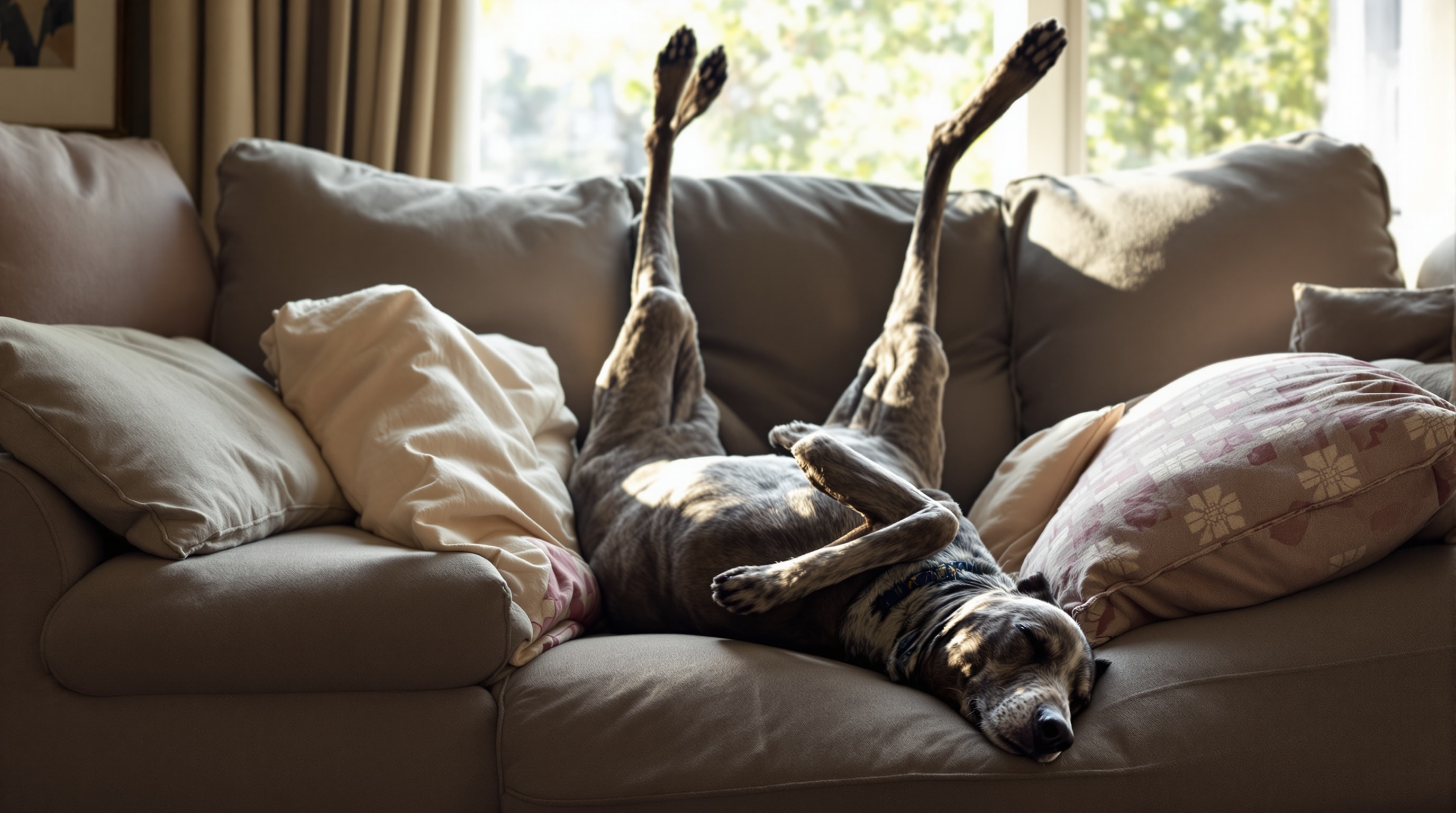
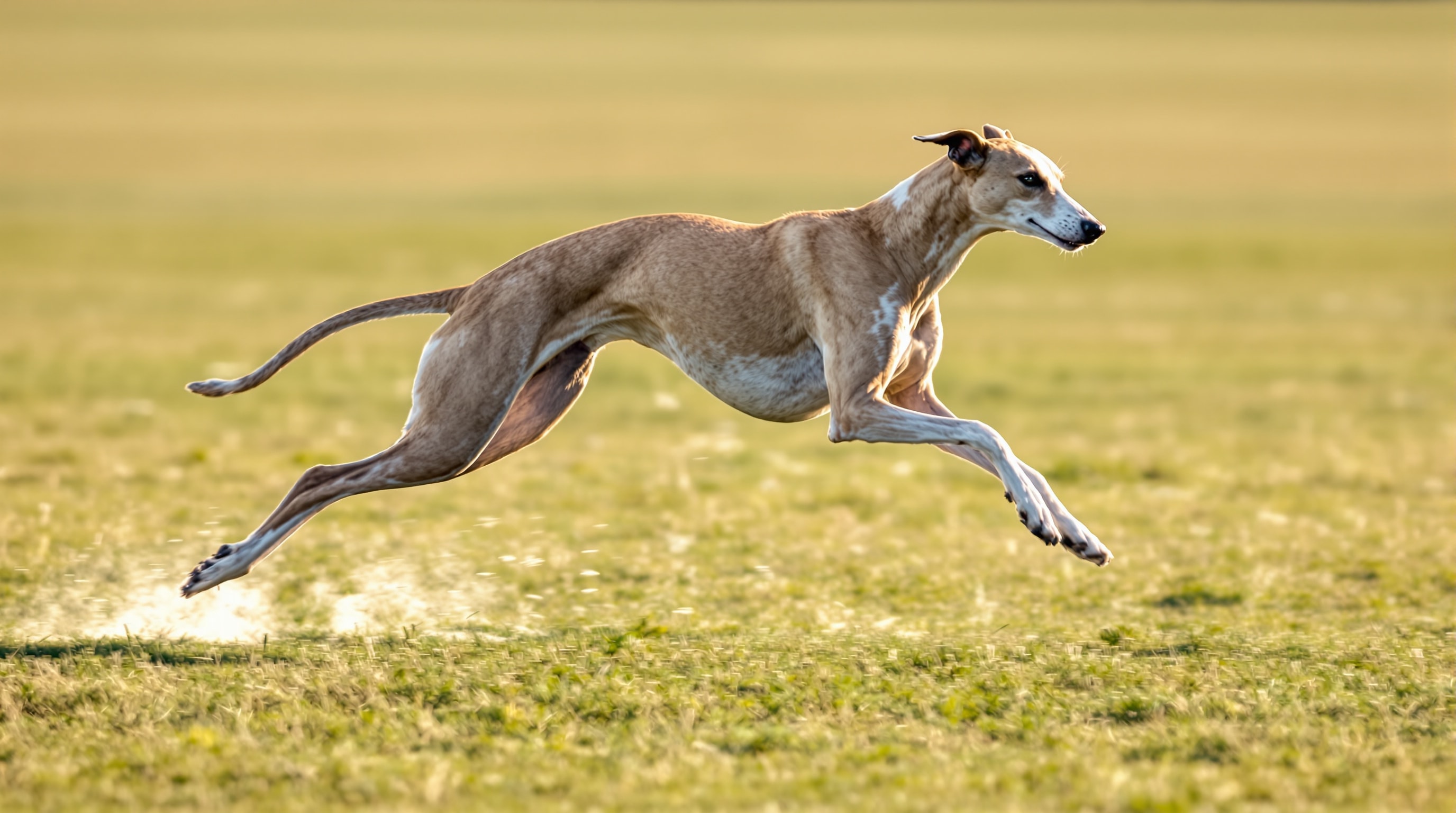
Retired racing Greyhounds typically sleep about 18 hours a day, and more if you let them. "Hyper" is not a word we would even consider applying to a Greyhound. They are commonly referred to as 45 mile per hour couch potatoes, still the most accurate short description of the breed anyone has managed. The fact is they don't HAVE to run at all, although they do relish a good sprint once in a while. A sprint, in our experience, lasts about thirty seconds and is followed by a nap that lasts until roughly Thursday.
If you want to see hyper, take a look at Lucky and Kristy's step-sister Zoe the Smooth Fox Terrier. OY VEY!!! One terrier produces more motion in an afternoon than three Greyhounds manage in a year.
Common Myth #2: Greyhounds are abused and mistreated at the track.
Greyhound racing in the U.S. is a business, not a slapstick comedy. You make money in business by winning, not by losing. You win at Greyhound racing with a healthy dog. Greyhounds are generally well cared for while actively racing. They may not enjoy the quality of life a dog deserves while on the track, but since it's the only life they know, they are not unhappy animals.
Once adopted they quickly figure out what they've been missing and seem truly grateful for the new life they have been given. Somewhere in the first week the dog works out that the sofa is not a trap, and that is a moment worth being present for. It happened to most of the dogs on our foster dogs page.
Common Myth #3: Greyhounds are large dogs that need lots of space to live in.
Well, they are not Chihuahuas, but they are indoor dogs. Greyhounds have virtually no body fat, so outdoor temperatures to either extreme are not tolerable to them. Even if you live in a house with a fenced yard, the dog will have to live indoors. A coat in a Seattle winter is equipment, not a fashion statement.
We lived in a two bedroom condo at one time and Porcia was very happy and comfortable there. The uninitiated are always amazed at how "small" a sleeping 65 pound Greyhound can be. They fold. A dog who takes up half a hallway standing becomes a modest heap the instant she lies down.
Common Myth #4: Greyhounds do not get along with other animals.
Well, this one is sometimes true. In some Greyhounds the "Prey Drive" is so strong that they can not live in homes with other animals. Most Greys, however, will get along quite well with other dogs, cats (Porcia loved cats) and other small animals. When they first come off the track they do not necessarily recognize other breeds as dogs, so if you have dogs of another breed there will be a learning curve to contend with. Our own household ran three Greyhounds and a Smooth Fox Terrier without incident, but the introductions were done slowly and on leash.
A good adoption group will have cat tested and small dog tested every dog in its care and will tell you honestly what the result was. A dog who cannot live with a cat is not a bad dog; he is a dog who should go to a home without one.
Common Myth #5: Greyhounds are "Special Needs" dogs that require a lot of your time.
This one is the absolute truth! Greyhounds do have special needs. They NEED at least a couple of soft places to sleep. They NEED love and affection from their humans. They NEED to be fed every day. As for demanding a lot of your time; if you want to sit and watch your Greyhound sleep 18 hours a day, well, fine. Frankly YOU probably NEED to get a hobby.
Common Myth #6: All retired Greyhound adoption groups are the same.
This is a really tough one. All retired Greyhounds deserve a good home and a long pampered life. However, if you are considering adopting, carefully examine the group you are adopting from. Examine their values and procedures. Examine their motives. ASK QUESTIONS!
Above all, make sure you know all that is known about the dog you are adopting, which may not be much in many cases, and make sure the dog's personality is a good match for your lifestyle. Just as with any breed, certain individual Greyhounds may have health or personality issues that you should know about before making a decision. Ray came to us with an active case of Pannus in both eyes and we went in knowing it, which is the only reason that story ended well.
Don't just choose the first dog that runs up and licks your chin. These dogs have already been through a lot of undeserved stress before they move into our homes. They do not need to be put through even more by being returned to the adoption group because the adopter wasn't aware of something about the dog or the breed.
Common Myth #7: Greyhounds are not dogs.
They are actually cyborg robots sent by aliens from Alpha Centauri to invade human sleeping spaces and thereby deprive us of sleep so that we don't notice the Alpha Centaurians when they raid our washing machines and steal one sock from each pair of argyles they find.
This is not a common myth at all. We just made it up because we wanted to have seven myths on this list. (But think about it...)
A Few Other Things We Have Learned
Not myths, just the things nobody thought to tell us.
Stairs are a foreign language
A racing kennel is a single-story building. Most retired racers have never encountered a staircase, and a dog who can hit forty five miles an hour in open ground can be completely defeated by four carpeted steps. They learn within a week or two, one leg at a time. Sliding glass doors, polished floors and full-length mirrors are equally new information.
House-training is usually the easy part
This surprises people. Track dogs live in a crate and are turned out on a schedule, and dogs raised that way arrive wanting to keep their sleeping space clean. The crate is not a punishment either; it is the one piece of furniture they already recognize.
Never off leash outside a fence
This is the rule we would keep if we had to throw all the others away. A sighthound runs on sight, not on recall. When something moves at the far end of a field the dog is gone before the thought of you has occurred to him, at forty miles an hour, in a straight line, toward a road he has not considered. Fenced yards and leashes, and nothing else.
They are not guard dogs
If you want a dog who will see off an intruder, buy a different breed. The typical retired racer's response to a stranger in the house is to raise his head, establish that the stranger is not carrying food, and go back to sleep.
They are quiet, and they are undemanding
A house with several Greyhounds in it is a calm house. They do not pace and they do not whine at you. What they want is company and a soft surface, in that order, and they will lean on you at length to make the first point.
Thin skin, and the need for soft bedding
A Greyhound has thin skin, a short coat and almost no padding over the bony parts of himself. Left to sleep on a hard floor he will develop bald patches and pressure sores on his elbows and hips. Good beds are not a luxury purchase for this breed, they are basic maintenance. Routine care otherwise is ordinary dog care, well covered by the veterinary profession's pet owner resources.
If you would rather see all this than read it, most of it is on display in the photo album. Particularly the sleeping.