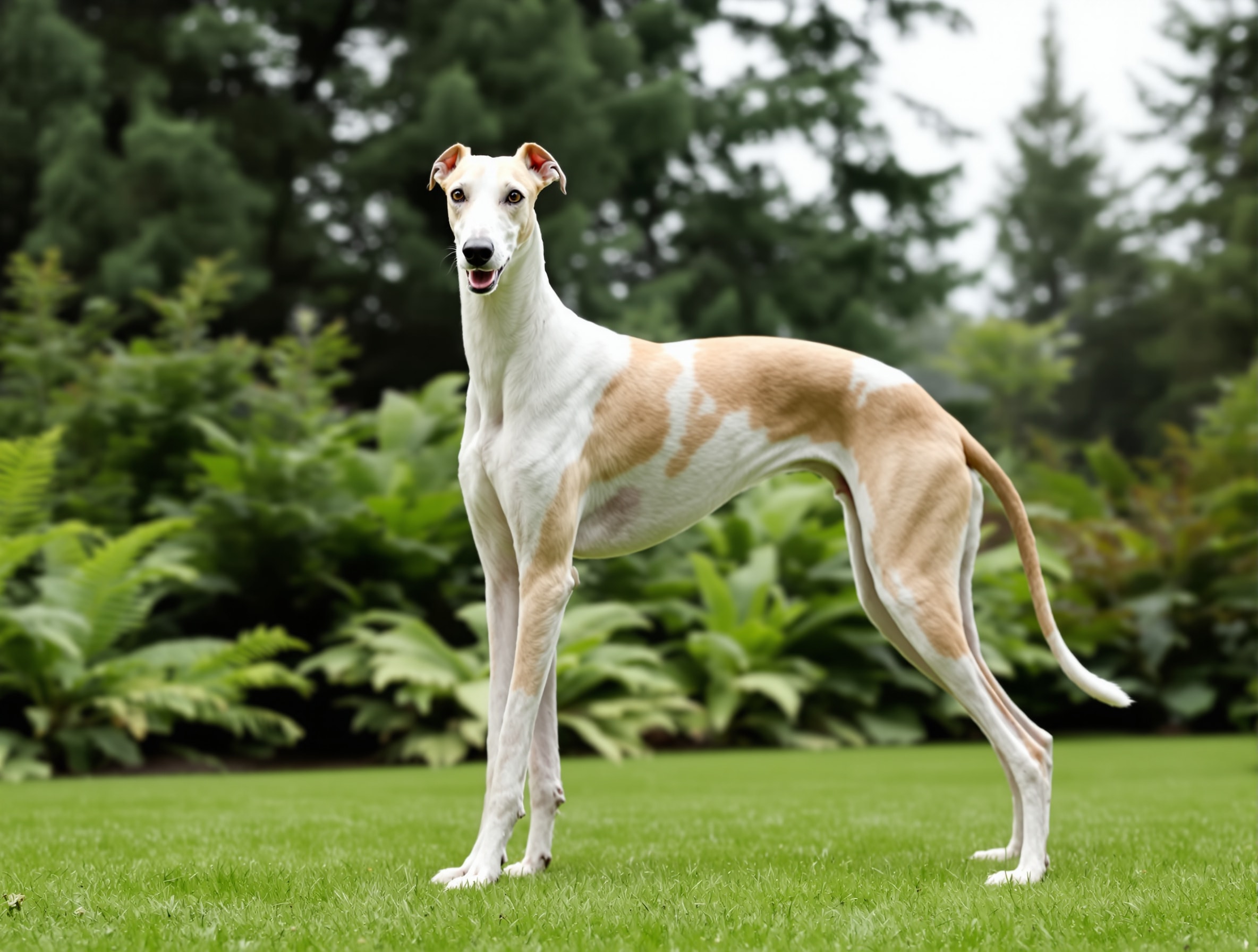
Flying Kiowa Ray
February 15, 1996 – August 26, 2005
Ray was diagnosed with bone cancer in April 2005 and passed away on August 26th. He was as great a dog as has ever lived and a superstar therapy dog who will be missed by countless people whose lives he touched.
I learned more about tolerance, teamwork and appreciating life in four years with Ray than I had in my entire life before he came along. Everyone who met Ray recognized immediately that there was something extraordinary about him; even something mystical. He never met a person he didn't like, regardless of their physical or emotional limitations.
The remainder of this page remains as it did before Ray's death, in hopes that you might get some sense of the joy he brought to our lives. We miss you terribly, Ray-Ray.
Vital Statistics
- Born: February 15, 1996
- Age at retirement: 5
- Races won: Gazillions
- Height: 29 inches
- Length: Slightly shorter than before two broken tail amputations
- Weight: 85 pounds (slightly less than before the broken tail amputations)
- Color: White and fawn
- Nicknames: Ray-Ray, Bubba, Klutz, and one further nickname the Webmaster has been instructed not to explain
- Favorite treat: Cheese curd from the public market
- Favorite toy: Opossums (they don't fight back like raccoons do)
- Accomplishments: A basic good-manners title from the national kennel club's good-citizen test, December 2002; therapy-animal certification, March 2003; accepted to the therapy dog team at a children's hospital, September 2004
In retirement, the rabbit chases YOU.
Ray's Story
We adopted Ray in January 2001 after inadvertently seeing his photograph and biography on the website of a Florida Greyhound rescue. Ray had languished in their kennel for several months by that point, presumably because nobody wanted to adopt him when so many healthy dogs were available. We were understandably apprehensive. He was nearly five years old, he had a very active case of Pannus in both eyes, and while we assumed he would get along with our other Greyhound, we had no idea how he might react to our Fox Terrier and we were entirely clueless about his general condition and personality.
Adopting a dog sight unseen from three thousand miles away is not something we would recommend to everybody. In our defense, we had read his biography roughly nine hundred times by the time we admitted to each other what we were going to do.
A Few Minutes of Leaning Time
Our first meeting with Ray took place in an airline cargo hangar on the night he arrived from Florida. He was so terribly thin that his hip bones looked as though they might break through the skin at any moment. He had an open, bleeding cut on his leg and, as we discovered soon afterward, he was horribly infested with every worm known to science.
Our first hint at Ray's unique personality came at that very moment. Even in that condition, and having just spent sixteen hours in a crate, he wanted to meet everyone present — the cargo staff included — and he gave each of us a few minutes of "leaning time." If you have not lived with a Greyhound, leaning is the breed's principal expression of affection: the dog reverses gently into your legs, puts its whole weight against you, and waits.
As it turned out, all of our worries were without foundation. Ray was a giant among Greyhounds — he eventually carried nearly ninety pounds — with a heart to match. His special qualities were apparent even to strangers on the street. When we walked in public with all three dogs, everyone we met was drawn to Ray first, and he greeted every one of them with that enormous smile. He may also have been the clumsiest dog in the history of the world, which is where the nickname Klutz came from, and which is why we eventually stopped leaving anything breakable at tail height.
Therapy Dog
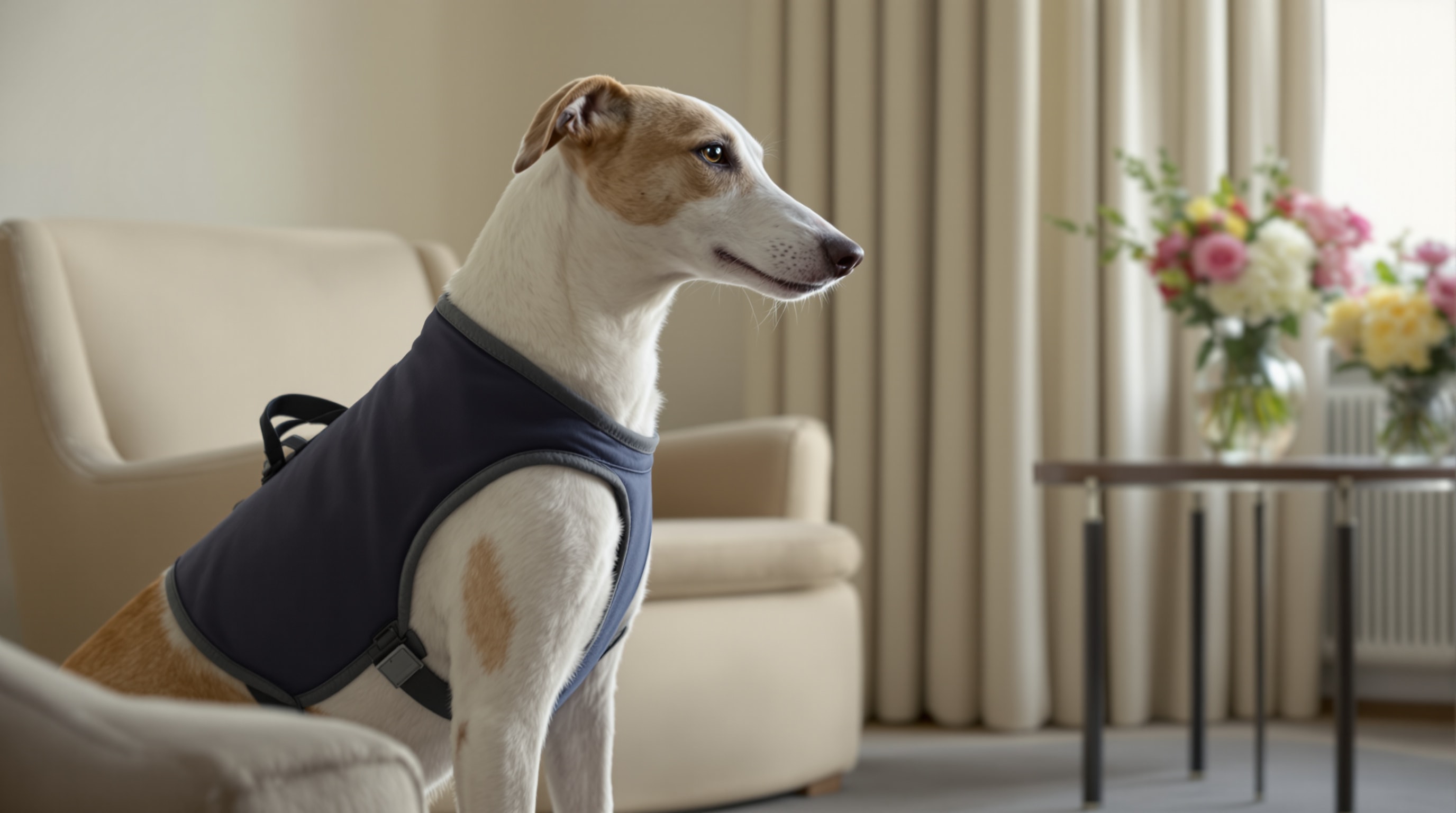
Ray's personality is what motivated us to train him for animal-assisted therapy and animal-assisted activities, and in March 2003 he was certified as a therapy dog through a national therapy-animal certification program, with his dad as handler. From then until his death he made regular volunteer visits to patients and residents at a hospice residence, a children's hospital and several other healthcare facilities around Seattle.
We will not describe those visits in any detail, and we never posted photographs of them; confidentiality belongs to the people being visited, not to us. What can be said is that Ray understood the job. He was different on a visit than he was on a walk — slower, softer, unhurried — and he was completely untroubled by wheelchairs, by equipment, by unsteady hands or by silence. He never met a person he didn't like, and that turned out to be a rarer and more useful quality than any amount of obedience training. There is more about how this work is structured, and what separates a therapy dog from a service dog, on our therapy dogs page. A therapy-animal magazine featured Ray and his dad in a Spring 2005 article about therapy dogs and hospice care.
Anyone curious about the research behind this work will find university animal-assisted-interaction programs, such as the one at Texas A&M's veterinary school, and the human-animal bond research community, far more rigorous than we are. Our thanks go to the local trainers and evaluators who put up with our antics and taught the two of us to work as a team.
Boxers or Briefs?
A photograph of Ray investigating the laundry inspired the line apparently Ray does have a preference. It became a favourite family joke. The laundry hamper was never safe, and the evidence was photographic. Kristy later took up the same hobby with socks — see her page for the full confession.
Bone Cancer
Osteosarcoma is common in large sighthounds, and it is fast. Ray was diagnosed in April 2005 and we had four months. He was still leaning on people in August. Anyone facing the same diagnosis will get better guidance from their own veterinarian and from resources such as the Cornell canine health center than from us; we are dog owners, not veterinarians, as our about page has always said.
What He Taught Us
Four years is not a long time. It was long enough to change how at least one person in this household thinks about patience, about work done for its own sake, and about the fact that a dog who had been abandoned in a kennel for months chose, in an airline hangar, to greet strangers instead of hiding from them.
Ray shares this website with Porcia, who was here before him, and with Lucky, who arrived after. We miss you terribly, Ray-Ray.