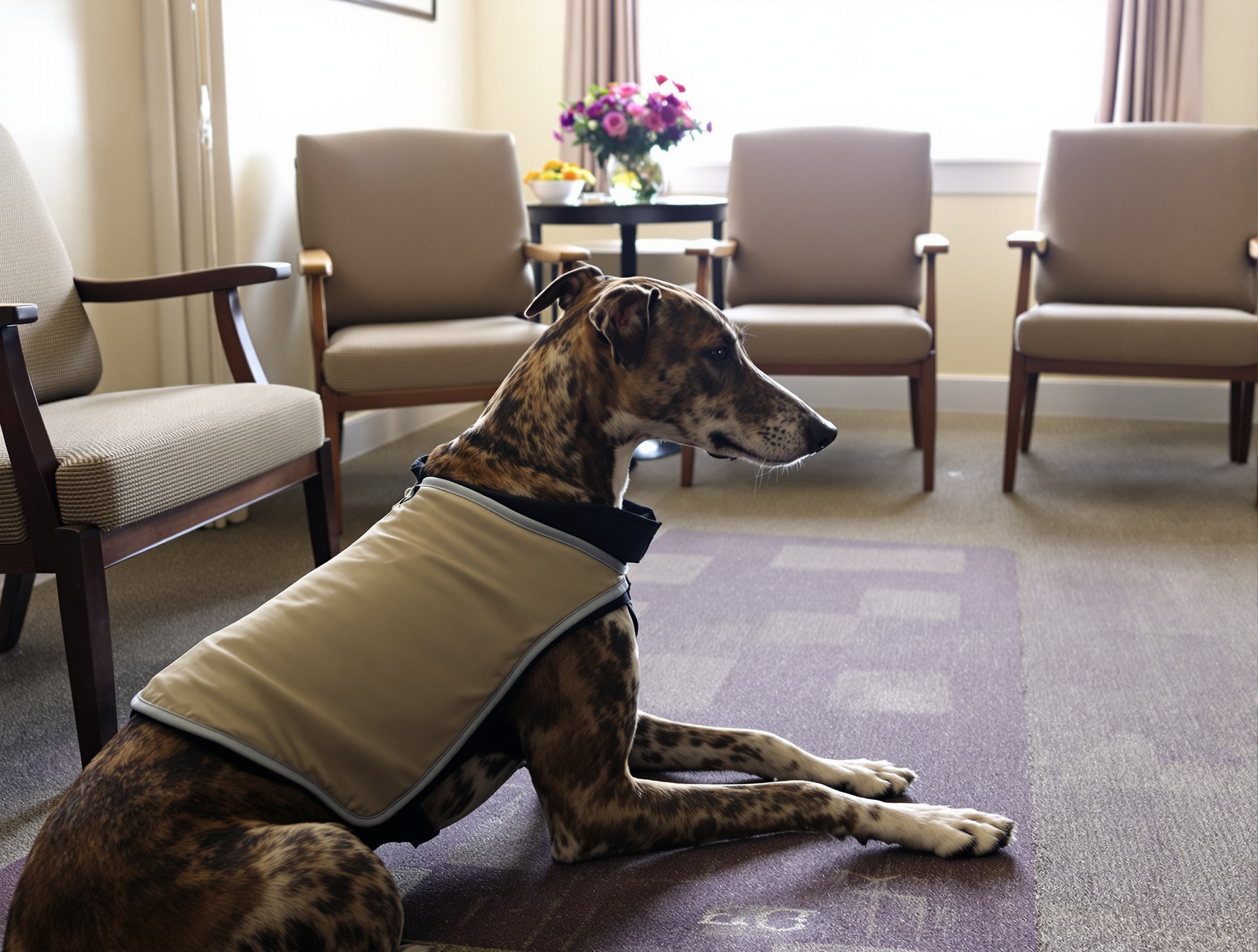
Therapy Dogs
Ray and Kristy were both certified as therapy dogs through a national therapy-animal certification program. Along with their human dad as handler they made visits to patients and residents at several Seattle area healthcare facilities on a volunteer basis.
This page offers some basic information on Animal Assisted Therapy and Animal Assisted Activities, on what the certification involved, and on the two Greyhounds who did the work. It is written by a volunteer handler and his family, not by a clinician.
What Is a Therapy Dog?
Therapy dogs are not service dogs. This is the single distinction we spent the most time explaining, usually in a hallway, usually to someone who had just met Ray. A service dog is individually trained to perform specific tasks for one person with a disability, works for that person alone, and has legal rights of access to public places. A therapy dog is somebody's pet. He belongs to a volunteer handler, he has no special access rights anywhere, and he goes only where he has been invited, on a schedule, as one half of a screened and certified team.
Therapy dogs provide animal contact to people who may or may not have disabilities. The certification program screens and trains volunteers and their animals for visiting programs in hospitals, nursing homes, rehabilitation centers, schools and other facilities. The handler is certified along with the dog, which is the part most people miss: it is the team that passes or fails.

Two Kinds of Visit
The work is usually sorted into two categories, and the difference is worth understanding because the two look similar from the doorway.
Animal Assisted Therapy is goal-directed. The animal is an integral part of a treatment process, and the session is directed or delivered by a health or human-service professional with specialized expertise, working within the scope of their own profession. It aims at a specific improvement in someone's physical, social, emotional or cognitive functioning, it may be individual or in a group, and every session is documented and evaluated afterward. If a therapist has decided that a patient will regain range of motion in an arm by brushing a dog, the dog is a piece of clinical equipment that happens to have a tail.
Animal Assisted Activities are the other category, and the majority of what most volunteer teams do. These are visits that provide motivational, educational, recreational or therapeutic benefit, intended broadly to improve quality of life, delivered in all sorts of settings by trained professionals, paraprofessionals and volunteers working with animals that meet the same screening criteria. There is no treatment plan and no chart entry. Somebody has a bad day, a large calm dog puts his chin on the bed for ten minutes, and the day is measurably less bad. There is a serious research literature behind that; the veterinary profession's overview of animal-assisted interventions is a good summary, and university programs such as this animal-assisted interaction research program study the effects properly.
The Evaluation
Certification is not a formality, and a well-behaved dog is not automatically a therapy dog. The evaluation tests temperament under conditions no ordinary obedience class produces on purpose. A dog is handled clumsily and all over by a stranger, hugged by someone he has never met, crowded by several people at once, petted from a wheelchair and from a bed, and walked past clattering equipment, raised voices and a stranger moving unsteadily. Somewhere in the middle a clipboard hits the floor behind him.
What the evaluator wants is not obedience so much as indifference. The dog should be neutral about all of it, leave dropped food alone, not jump, not startle into a lunge, and sit quietly for examination while somebody looks at his feet and ears. The handler is watched at the same time, for whether he notices what his dog is telling him and whether he will take the dog out of a situation before the dog has to sort it out himself.
Why Greyhounds Often Suit the Work
Greyhounds turn up in this work more often than their numbers would suggest, and the reasons are practical. They are exactly the right height: a Greyhound standing beside a bed or a wheelchair can be reached and stroked without anyone lifting a dog or bending down. They are quiet, they do not jump, and they will stand still for a long time. The short coat is easy to keep clean between visits.
Track life prepares them in a way nobody planned. A racing Greyhound has been handled by strangers his whole life, weighed, examined, led about in crowds and moved around in transport crates, so a corridor full of unfamiliar people and equipment is nothing new. The ordinary breed cautions still apply: these are thin-skinned dogs who cannot stand a long hot corridor and who need somewhere soft when the shift is over. More on that on our Greyhound facts page.
Ray
Ray began his career as a therapy dog in March 2003 and kept at it for the rest of his life. His gregarious personality was particularly well suited to the work and he seemed to truly enjoy his job. He never met a person he did not like, regardless of their physical or emotional limitations, and he had the useful gift of leaning gently on whoever needed leaning on.
While it is impossible to know exactly what these dogs understand, Ray seemed to have some comprehension of his role and the purpose of his visits. He behaved differently on visiting days from the moment the equipment came out. If only they could talk.
Kristy
Kristy passed the therapy-animal evaluation with her dad in March 2005 and began visiting soon afterward. In March 2006 she was accepted onto the therapy dog team at a children's hospital, which we were quietly and enormously proud of. She is a different sort of visitor from Ray: where he was stately, she is a Kamikaze Kissing Machine, and a good deal of her training consisted of learning to keep her tongue to herself for an entire hour.
A Note on Privacy
Confidentiality prohibits us from ever posting pictures of an actual visit, or from writing about any person we met on one. Nothing on this site describes a patient or a resident, and nothing identifies a facility. The photographs here were taken in our therapy dog classes and evaluations, and the people in them are role-playing volunteers, not patients or healthcare professionals.
The dogs who did this work have their own pages, and both of them are worth reading before this one: Flying Kiowa Ray and Lift Off "Kristy". There are more pictures of both, out of uniform, in the photo album.